How to Choose the Right Book Style for Your Child
Choosing the right book for your child is about matching their age, reading level, and interests. Here’s a quick guide:
- Board Books (Ages 0–3): Durable with simple, high-contrast visuals for sensory exploration and early learning.
- Picture Books (Ages 3–8): Short stories with vibrant illustrations to build imagination and visual literacy.
- Early Readers (Ages 5–8): Simple text with controlled vocabulary to encourage independent reading.
- Chapter Books (Ages 6–9): Longer narratives with minimal illustrations to develop reading stamina.
To keep kids engaged:
- Let them choose books that match their interests (93% of kids prefer books they pick themselves).
- Use tools like the “Five Finger Rule” to ensure the text is at the right difficulty level.
- Consider personalized storybooks, such as those from Leo Books, to make reading more exciting by putting your child in the story.
The goal is to nurture a love for reading while supporting their development step by step.
How to Choose the Right Book for Your Child

Book Categories by Age and Development Stage

Finding books that align with your child’s age isn’t just about picking something they can physically handle - it’s about supporting their developmental milestones. Each type of book is crafted to nurture specific physical, cognitive, and language skills.
Board Books (Ages 0–3)
Board books are all about hands-on exploration, not intricate storytelling. Made from sturdy cardboard with rounded edges, these books are built to withstand chewing, dropping, and all the rough handling that comes with curious little hands [5][6]. Considering that 90% of brain development happens before children even start kindergarten [7], these early book interactions are incredibly important.
Newborns can only see clearly up to about 12 inches away [4][9], which is why the best board books for this age feature high-contrast black-and-white images or bright primary colors. As babies grow, these books introduce them to basic concepts like colors, shapes, and simple words, usually with a word count between 0 and 200 [6][8].
“Board books are not about deep storytelling. They’re about sensory exploration. Babies learn that pages turn, pictures represent things, and words can accompany images.”
For families speaking multiple languages, board books are especially helpful. Pointing to a picture of a dog and saying the word in two different languages won’t confuse young children - it actually helps them learn [5]. Repetitive text and rhythmic patterns in these books also help build phonological awareness, a skill crucial for future reading [5].
Building on this sensory foundation, picture books introduce storytelling that connects emotionally with young readers.
Picture Books (Ages 3–8)
Picture books take children beyond sensory exploration, offering simple stories paired with vibrant illustrations. These books, typically 32 pages long [6][8], rely on illustrations to tell at least half the story [6]. The text, which generally ranges between 200 and 800 words [6][8], introduces kids to basic narrative structures with clear beginnings, middles, and ends.
These books also develop visual literacy. Kids learn to interpret facial expressions, follow action sequences, and understand perspectives - all skills that will help them as they advance in school.
Early Readers and Chapter Books (Ages 5–9)
As stories become more complex, children transition from heavily illustrated books to ones that emphasize text. Early readers (ages 5–8) are designed to bridge the gap to independent reading, while chapter books (ages 6–9) help build the stamina needed to follow longer narratives.
Early readers use controlled vocabulary, focusing on sight words and simple, decodable patterns. Sentences are short - usually 5 to 10 words - and the text ranges from 200 to 2,000 words [6]. Illustrations are still present but mainly serve to support comprehension as children decode the text.
Chapter books, on the other hand, take a bigger step forward. With word counts between 5,000 and 35,000 [8] and fewer illustrations, these books shift the storytelling burden to the text. They encourage kids to follow more intricate plots and delve into character development, often across multiple sittings. Series formats are particularly effective at this stage, as familiar characters can boost confidence and engagement [6].
| Feature | Board Books (0–3) | Picture Books (3–8) | Early Readers (5–8) | Chapter Books (6–9) |
|---|---|---|---|---|
| Material | Thick cardboard | Paper | Paper | Paper |
| Word Count | 0–200 words | 200–800 words | 200–2,000 words | 5,000–35,000 words |
| Primary Purpose | Sensory exploration & basics | Storytelling & imagination | Independent reading practice | Reading stamina & complex plots |
| Illustration Role | Bold, simple subjects | Integral to storytelling (50%) | Supports text decoding | Minimal; text takes the lead |
Matching Book Styles to Your Child’s Interests
While selecting books based on age and reading level is important, aligning them with personalized storybooks based on your child’s interests is what truly keeps them engaged. A book might be perfectly suited to their reading ability, but if the topic doesn’t excite them, it’s likely to gather dust. The good news? Figuring out what sparks your child’s curiosity is easier than you might think. Ask them specific questions like, “Do you want something funny or an adventure story?” and pay attention to what naturally grabs their attention. If they’re into a particular video game or TV show, look for books that expand on those worlds, and don’t hesitate to ask teachers for tips on what might resonate [12].
Here’s a telling fact: 93% of kids say their favorite books are the ones they choose themselves [11]. A simple tweak like displaying books with their covers facing outward, rather than just showing the spines, can make a big difference in sparking curiosity. And if you’re unsure whether a book will click, try the “one chapter” test - read the first chapter together, and if it doesn’t grab their attention, move on to the next option [11].
Here are a few themes to consider when matching books to your child’s interests:
Adventure and Fantasy Themes
For kids who love excitement and magical possibilities, adventure and fantasy books are a great fit [2]. These stories fuel the imagination and often come in series, which can be a win for readers who enjoy following a beloved character through multiple adventures [13][3]. Series also save kids from having to adjust to a new world every time they pick up a book [12]. While younger readers might enjoy simpler adventure tales, children around 9 and older often dive into more complex fantasy worlds and big ideas [11][3].
Humor and Everyday Stories
Humor is a top priority for many kids when choosing a book [11]. Lighthearted, funny stories - especially those with playful or even slightly irreverent humor - resonate strongly with middle-grade readers [2][14]. Everyday stories, on the other hand, focus on relatable themes like school, family, and friendships, helping kids make sense of their own experiences [4][13][2]. As Amanda Maciel, Executive Editor at Scholastic, explains:
“A great children’s book makes readers feel seen and understood” [11].
For younger children, books that reflect their daily lives can create that important sense of connection and understanding.
Educational and Nonfiction Books
Nonfiction books are perfect for curious kids who are always asking “why” and “how.” Whether it’s space, dinosaurs, history, or mechanics, nonfiction shows kids that books can answer their biggest questions [2][3]. To keep things engaging, try mixing formats - pair a rhyming picture book about dinosaurs for bedtime with a more detailed nonfiction book about archaeological digs for independent reading [3]. Graphic novels and illustrated books are also excellent options, especially for reluctant readers or those who thrive on visual storytelling [10][11]. These formats combine text and images, making complex topics easier to grasp.
One surprising statistic highlights a common challenge: 40% of readers aged 6 to 17 struggle to find books they enjoy, but only 28% of parents are aware of this issue [12]. As Cassie Thomas, a teacher, puts it:
“If they’re going to be hands-on, parents need to allow and accept what their child is into” [12].
Ultimately, the best book isn’t always the one you’d pick - it’s the one your child can’t wait to read.
Personalized Storybooks: Making Your Child the Hero
Personalized storybooks take reading to a whole new level by making your child the star of the story. Instead of simply following along, your child becomes the hero, creating a deeper connection to the narrative. This unique approach offers several benefits that make storytime more engaging and memorable.
How Personalization Boosts Engagement
When a child sees their own name, face, or even their favorite toy in a story, it transforms reading into a personal adventure. It’s no longer just a book - it’s their book. This personal touch not only makes the experience more enjoyable but also helps improve memory retention. Kids are more likely to remember new words and lessons when they feel directly involved in the tale.
Personalized books can be especially helpful during big life changes. Whether it’s starting school, welcoming a new sibling, or moving to a new house, these stories can guide children through these transitions by making them the hero of their journey. Adding familiar characters like siblings, pets, or beloved stuffed animals as sidekicks adds another layer of comfort and connection.
Leo Books offers a range of customization options to make these stories even more special, tailoring each book to reflect your child’s unique world.
Customization Options with Leo Books
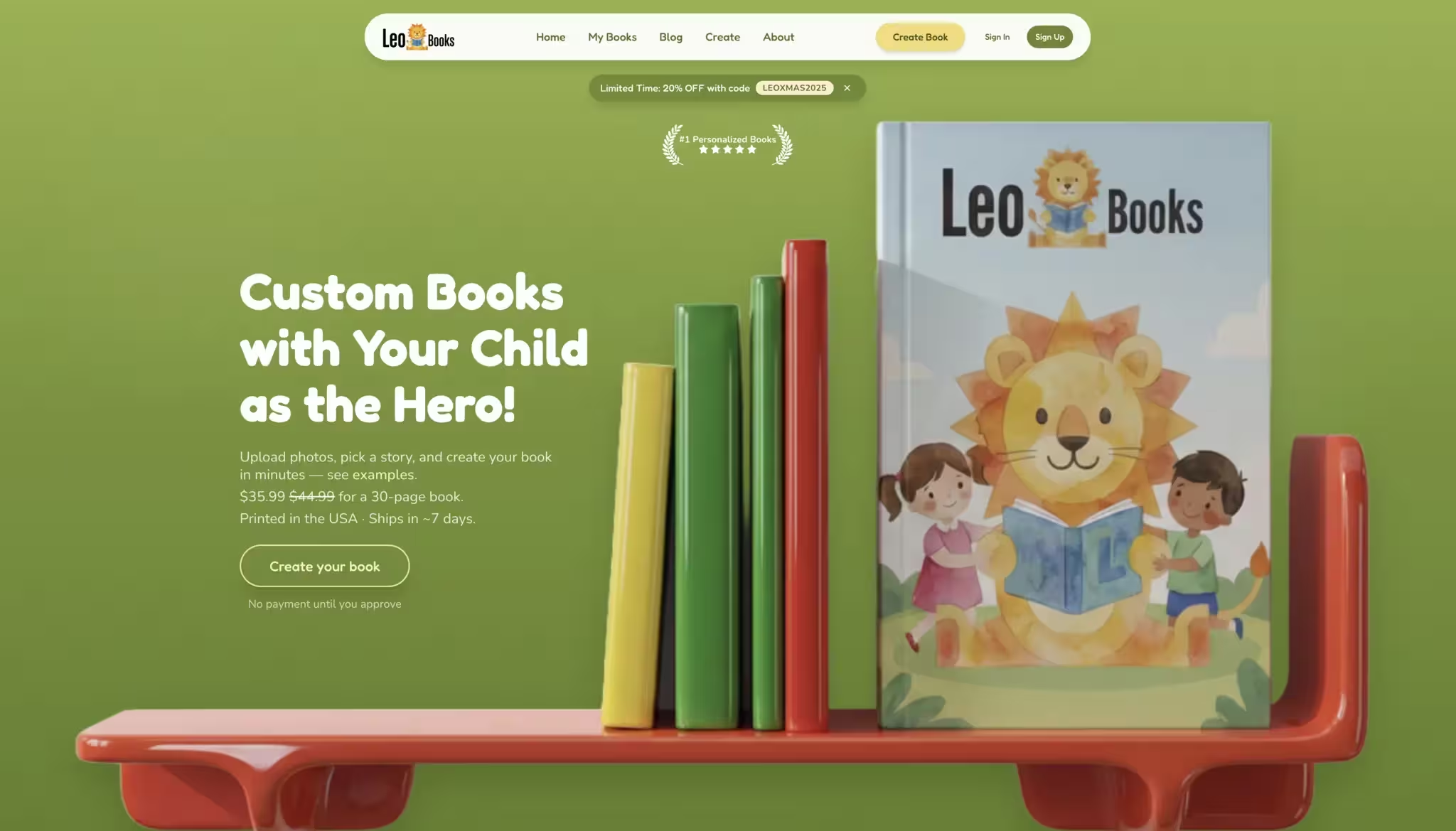
Leo Books takes personalization to the next level by allowing parents to customize nearly every aspect of the story. You can upload 10–15 photos to create AI-generated illustrations that capture your child’s features and expressions. Choose from eight artistic styles, including watercolor, bold cartoons, 3D designs, vector graphics, geometric pop, and sketch-inspired whimsy, to match your preferred aesthetic.
With over 40 story templates to explore, there’s something for every child. Themes range from Adventure (like dinosaurs, space, and unicorns) to Holidays, Sports, Careers, and Life Events. For those who want something truly one-of-a-kind, the “write your own story” option lets you craft a completely unique tale. The text even adapts to your child’s age, using playful rhymes for younger readers (ages 0–4) and more detailed prose with advanced vocabulary for kids aged 5–10.
Leo Books offers multiple formats to suit your needs. You can get a digital PDF for $8.99, a softcover edition for $35.99, or a durable hardcover for $44.99. Plus, right now, you can save 20% on your order with the code HAPPY2026.
How to Evaluate Text Complexity and Reading Levels
Choosing books that align with your child’s reading abilities keeps them engaged and helps them grow without feeling overwhelmed. Experts suggest that children should read with 95% accuracy or higher for independent practice. Anything below 90% accuracy might be too challenging and could lead to frustration [19].
There are several systems to assess a book’s difficulty. The Lexile Framework rates texts from 0L to 2000L, while Guided Reading Levels use letters A through Z. Many schools rely on the Developmental Reading Assessment (DRA), which ranges from 1 to 80. However, these are just tools, not strict rules [18]. Dr. Amanda Alexander, Chief Academic Officer at Scholastic, emphasizes:
A Lexile level is only one measure of your child’s holistic reading ability [16].
For a quick at-home test, try the Five Finger Rule: have your child read a page and hold up a finger for every unfamiliar word. Zero to one finger means the book is easy, two to three fingers indicate it’s a good fit, while five or more fingers suggest it’s too difficult. You can also calculate accuracy by dividing the number of known words by the total words on the page [18][19].
Interestingly, kids may succeed with books slightly above their reading level if they’re excited about the subject - whether it’s dinosaurs, sports, or space [15]. Professor Emerita Adria Klein from California State University San Bernardino explains:
Levels are more about books, but not about kids. They vary. They’re a guide, not a rule [15].
Online tools like Scholastic’s Book Wizard and Lexile Find-a-Book make it easy to check a book’s reading level by scanning its ISBN [17].
Emergent Readers (Ages 4–6)
At this stage, children are beginning to connect letters and sounds. They rely heavily on illustrations to predict and confirm meaning [20]. Books for emergent readers should have repetitive patterns, large, bold fonts, and plenty of pictures.
“Decodable” texts are ideal - they use simple word patterns kids have already learned, like “A cat sat on a mat” [21]. These books usually contain 300 to 1,500 words and follow basic sentence structures like subject-verb-object [21]. Avoid books with complex sentence arrangements (e.g., “After school, I went home”) or text that weaves across the page, as these can confuse early readers [15].
By first grade, kids encounter approximately 2,000 multi-meaning words, so keeping the language straightforward and predictable builds their confidence [15]. Illustrations should clearly support the text, though inconsistent artwork can sometimes distract young readers [15].
Developing Readers (Ages 6–8)
Developing readers, also called transitional readers, are building stamina for 15- to 20-minute reading sessions and learning to decode multi-syllabic words [22]. They’re ready for chapter books with short chapters, larger print, and plenty of white space to keep the experience approachable [22].
Series books work well at this stage because familiar characters and settings help kids focus on fluency rather than adjusting to new story elements [22]. Books like Henry and Mudge by Cynthia Rylant offer relatable stories with accessible vocabulary and helpful illustrations. As Reading.com notes:
Choosing the right first chapter books can make the difference between a confident reader and a frustrated one who gives up too easily [22].
At this level, children begin transitioning from heavily illustrated books to those with fewer pictures - perhaps one every few pages instead of one per page. They should be able to read 95% of the words independently. If they struggle with more than one word per sentence, the book is likely too advanced [22].
Fluent and Advanced Readers (Ages 8+)
Fluent readers are confident and independent, ready to handle books with longer chapters, complex themes, and fewer illustrations. They’ve moved from “learning to read” to “reading to learn”, tackling advanced vocabulary, multiple storylines, and abstract ideas [1].
Books for this group often include features like indices, captions, and figurative language, which add depth to the reading experience [15]. The Pacific Resources for Education and Learning explains:
The Stages of Reading Development is a continuum that explains how students progress as readers. These stages are based on the students’ experience and not their age or grade level [20].
This means some eight-year-olds may still need simpler texts, while others are ready for middle-grade novels. Research shows that children reading books matched to their skill level experience stronger vocabulary growth than those reading texts that are too easy or too hard [1].
Keep using tools like the Five Finger Rule and online leveling systems to find books that challenge without overwhelming.
Conclusion
Finding the perfect book for your child doesn’t have to be complicated. It’s all about matching the right format to their age and needs: board books for little ones (ages 0–3) who need sturdy pages for sensory exploration, picture books for young readers (ages 3–8) who thrive on visual storytelling, and chapter books for older kids (ages 6–9) ready to develop independence. A quick tip: if your child struggles with three or more unfamiliar words per page, the book might be too advanced for independent reading [23].
Tap into what excites your child. Whether they’re obsessed with dinosaurs, outer space, or their favorite stuffed animal, books tied to their interests often lead to more engagement and repeat reading. In fact, kids are more likely to tackle slightly challenging books when the topic sparks their curiosity.
For an extra-special touch, personalized storybooks from Leo Books make your child the star of the story. By uploading 10–15 clear photos, selecting artistic styles like watercolor or bold cartoon, and previewing the final product, you can create a hardcover book that feels uniquely theirs. This approach ties perfectly into choosing books that match both their reading level and their personal interests.
FAQs
What if my child’s age and reading level don’t match?
If your child’s age and reading level don’t match, prioritize their developmental stage and literacy skills. For younger kids who read beyond their age level, consider picture books or interactive options that still capture their interest. For older kids reading below their age level, look for books with straightforward language and captivating illustrations. The key is finding books that fit their abilities, making reading both fun and a tool for progress.
How can I help a reluctant reader find books they’ll actually finish?
To help a reluctant reader, start by selecting books that align with their personal interests and reading ability. If they love excitement, try adventure stories, or if they enjoy visuals, graphic novels might be a great fit. Letting them choose titles that genuinely catch their attention can make a big difference. You could also introduce formats like picture books or interactive options to make reading feel more enjoyable. The key is to find books that hit the sweet spot - challenging enough to keep them engaged but not so difficult that they feel overwhelmed. This balance builds confidence and motivates them to complete what they start.
Are personalized storybooks worth it for building reading habits?
Personalized storybooks can work wonders in helping kids develop strong reading habits. By placing children at the heart of the story, these books not only grab their attention but also build their confidence and emotional awareness. When kids see themselves as the hero, they’re more likely to reread the story, which strengthens their vocabulary and boosts word recognition. Beyond that, these books create a personal connection to the narrative, making reading feel more meaningful and enjoyable. This combination of engagement and emotional resonance can nurture a lifelong passion for reading.