Hero Stories Teach Kids Problem-Solving
Hero stories aren’t just fun - they help kids learn problem-solving and decision-making skills. Research shows that when children engage with heroic tales, they practice thinking through challenges, understanding consequences, and managing emotions. Personalizing these stories makes the lessons even more relatable, helping kids connect deeply with the hero’s journey.
Key takeaways:
- Problem-solving skills: Heroic narratives teach kids to break challenges into steps and think flexibly.
- Emotional growth: Stories show how heroes overcome fear and setbacks, building resilience.
- Personalized storytelling: When kids see themselves as the hero, they gain confidence and apply lessons effectively.
- Interactive learning: Discussing a hero’s actions with peers or adults boosts creativity and critical thinking.
Hero stories provide a fun, engaging way to help kids grow into confident problem-solvers. By tailoring these tales to your child’s interests, you can turn story time into a powerful learning experience.
Research on Hero Stories and Problem-Solving
What Child Development Studies Show
Research indicates that hero stories can boost children’s cognitive and social skills. A 2024 meta-analysis highlighted that reading fiction enhances empathy and mentalizing - the ability to understand others’ thoughts and emotions - with a measurable effect size (g = 0.14) [9].
One standout study, published in the Journal of Experimental Child Psychology, explored the impact of fantastical play on executive functions. Researchers from the University of Alabama worked with 110 preschoolers, aged 3 to 5, over five weeks. Children who engaged in imaginative scenarios - like pretending to fly cars or exploring outer space - showed notable improvements in working memory and attention-shifting compared to those in non-imaginative or control groups [6]. The study defined executive functions as:
Higher order thinking processes that allow individuals to override more automatic thoughts and behaviors for more adaptive and goal-directed responses [6].
This ability to switch between fantasy and reality strengthens cognitive flexibility. When children immerse themselves in hero stories, they repeatedly move between pretense and reality, which sharpens their adaptability and problem-solving skills [6].
Adding a layer of personalization to these narratives enhances these benefits even further.
How Personalized Stories Improve Learning
Personalized storytelling takes the advantages of imaginative play a step further by making narratives more relatable. When adults and children discuss a hero’s challenges together, it boosts problem-solving and storytelling skills. Research shows a moderate positive effect (g = 0.425) from interactive reading, with longer programs (17 weeks or more) showing even greater benefits (g = 0.644) compared to shorter ones (under 8 weeks, g = 0.267) [7].
A study led by Joris Van Elsen and colleagues at the University of Antwerp in June 2023 tested 130 preschoolers aged 4 to 6. Over five interactive picturebook sessions, children explored solutions for characters in stories like Gu’s Garage and Deep-sea Doctor Derek. Using Pictorial Multiple-Solutions Tasks, the researchers measured three problem-solving skills: fluency (number of solutions), flexibility (variety of solution types), and originality (uniqueness of ideas). Results confirmed that interactive reading significantly improved all three areas [8].
Interestingly, peer interaction during these storytelling sessions had the strongest impact (g = 0.675), outperforming teacher-led (g = 0.164) and researcher-led (g = 0.459) approaches [7]. When children share ideas about how a hero might solve a problem, they gain a deeper understanding than when adults provide the answers directly. This collaborative process encourages creativity and critical thinking.
The Problem Solving Superhero | A story about independence
How Hero Stories Develop Problem-Solving Skills
Planning and Flexible Thinking
When heroes face seemingly impossible challenges, kids begin to think outside the box, exploring different ways to overcome obstacles. This type of imaginative problem-solving is a key step in developing effective strategies for real-life scenarios [10].
Studies reveal that children aged 3 to 5 are more likely to adopt problem-solving techniques when heroes with fantastical powers tackle challenges using realistic methods [3]. For example, a superhero who can fly but still needs to figure out how to unlock a door teaches kids that even extraordinary abilities don’t eliminate the need for practical thinking. It’s about breaking problems into manageable steps rather than relying solely on magical solutions.
“The findings suggest that fantastical stories in which characters have the ability to do impossible things but use realistic solutions to problems can be effective in teaching children how to solve physical problems.” [3]
Hero stories also teach narrative sequencing, helping kids understand how one event leads to another and how specific settings create unique challenges that require tailored solutions [5][10]. This kind of flexible thinking not only sharpens problem-solving skills but also helps children regulate emotions when faced with difficulties.
By practicing these cognitive strategies, children build a foundation for emotional resilience and confidence.
Building Confidence and Managing Emotions
Hero stories often highlight moments of self-doubt, fear, or failure. Watching their favorite hero wrestle with a “Supreme Ordeal” or hesitate before taking on a tough challenge helps kids see their own struggles reflected in the story [2]. This connection plays a big role in emotional growth.
In a two-year study involving 813 problem-solving stories from 353 children aged 8–10, researchers found that using narrative-based interventions improved self-awareness, emotional regulation, and decision-making skills more effectively than traditional methods [1]. One key technique is externalizing, where challenges are framed as external obstacles rather than personal flaws. For example, instead of thinking, “I’m bad at math”, a child may view the challenge as a “math monster” they can defeat with effort and strategy [1].
“Narrative therapy practices such as externalizing and re-authoring can significantly contribute to the development of children’s social and emotional skills.” - Marie-Nathalie Beaudoin, PhD [1]
By the age of 6, children can grasp a hero’s goals and understand why persistence matters, even when things go wrong [11]. Watching a hero push through setbacks reinforces the idea that struggles are part of learning and growth. This lesson encourages kids to stay determined, even when the going gets tough.
Hero Stories vs. Generic Stories
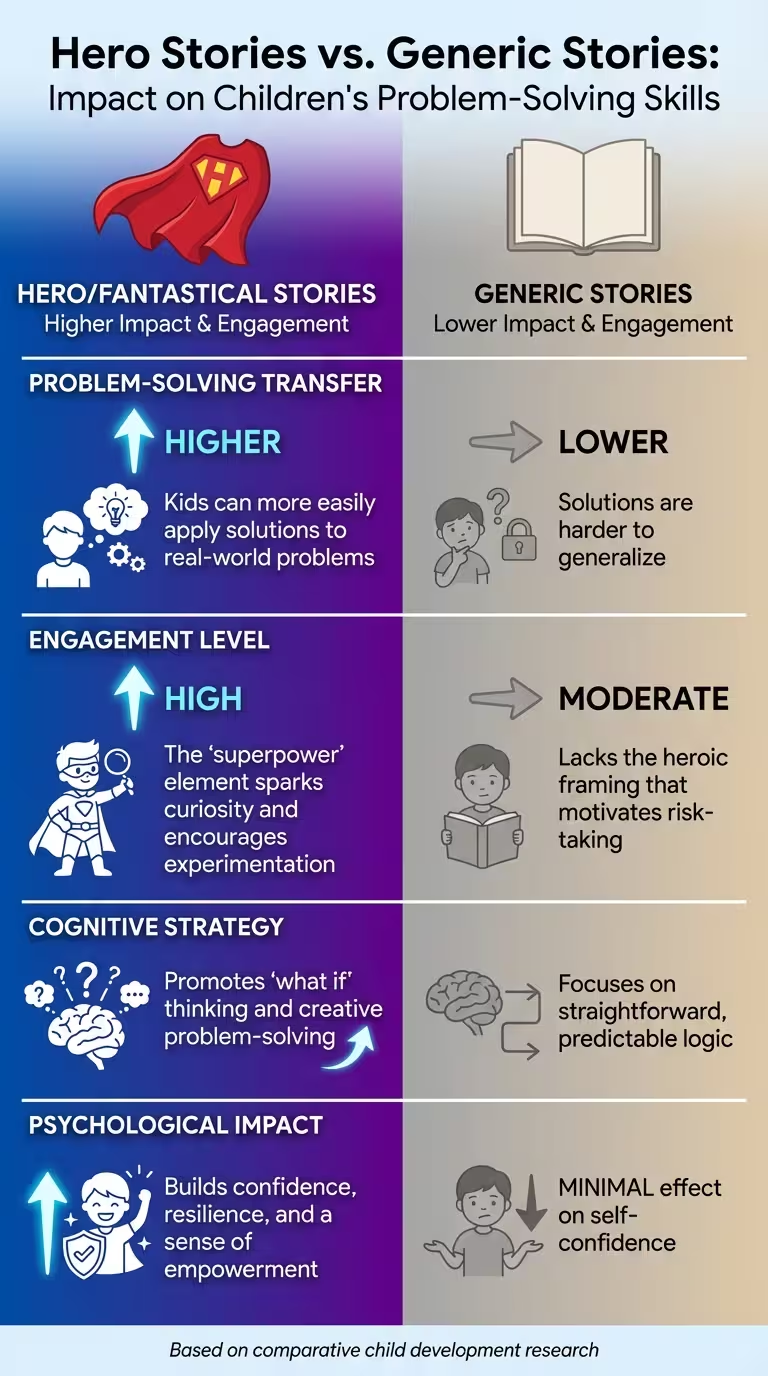
Comparative studies show that hero stories have a unique edge in fostering problem-solving skills. Here’s how they stack up against more generic narratives:
| Feature | Hero/Fantastical Stories | Generic Stories |
|---|---|---|
| Problem-Solving Transfer | Higher; kids can more easily apply solutions to real-world problems [3] | Lower; solutions are harder to generalize [3] |
| Engagement Level | High; the “superpower” element sparks curiosity and encourages experimentation [10] | Moderate; lacks the heroic framing that motivates risk-taking [10] |
| Cognitive Strategy | Promotes “what if” thinking and creative problem-solving [10] | Focuses on straightforward, predictable logic [3] |
| Psychological Impact | Builds confidence, resilience, and a sense of empowerment [4][12] | Minimal effect on self-confidence |
The key difference lies in how children connect with the characters. Hero stories encourage critical thinking by presenting complex challenges that require intelligence and specific skills - not just luck or adult intervention [12]. When a superhero uses clever strategies to defeat a villain, kids learn that solving problems step by step is far more empowering than waiting for someone else to step in.
A December 2025 review in SSM - Mental Health analyzed 39 studies on hero-based programs and found that these stories consistently improved health and educational outcomes for young people [4]. By giving kids a framework to see themselves as capable problem-solvers, hero stories help shift their mindset from passive to proactive.
How Hero Stories Work in Practice
Case Study: Hero Stories for Children with Autism
In November 2016, a study led by Marie-Nathalie Beaudoin and her team examined how storytelling could help children tackle challenges. Over two years, they analyzed 813 problem-solving stories from 353 children aged 8–10. Using narrative therapy techniques like externalizing, the study encouraged kids to see their struggles as external “villains” they could overcome. For instance, one child reimagined a tantrum as a monster they could outsmart. This reframing helped children - particularly those on the autism spectrum - develop better coping skills, manage their emotions, and show increased empathy. The results highlighted how narrative therapy can turn abstract difficulties into concrete obstacles that young “heroes” can face and conquer.
Beyond self-management, hero play also plays a role in improving language and empathy skills.
Hero Play’s Effect on Language and Empathy
Imaginative play takes the benefits of narrative therapy to another level, enhancing critical cognitive abilities. A May 2016 study observed 110 preschoolers (ages 3–5) over a five-week period. Children engaged in fantastical play - such as pretending to be flying cars or rescuing imaginary creatures - showed notable improvements in working memory and their ability to shift attention. These gains were not observed in children who participated in non-imaginative play or were part of a control group. The research revealed that switching between reality and pretense in hero play strengthened key executive functions, which are essential for language development and understanding social cues. Immersing in these imaginative hero roles provided the greatest cognitive and social benefits[6].
How to Use Hero Stories at Home
Making Personalized Hero Stories
Personalized hero stories let your child become the star of their own adventure. Research published in Child Development in 2017 revealed that kids pretending to be characters like Batman or Dora the Explorer stayed more focused during boring tasks compared to when they thought of themselves in the first person [14].
You can create these adventures using platforms like Leo Books. Simply upload your child’s photos, choose artistic styles, and craft a custom narrative. These stories not only captivate but also reinforce problem-solving skills in a fun and engaging way.
Making Storytelling Interactive
Interactive storytelling takes engagement to the next level by actively involving your child in the creative process. For instance, during a July 2015 workshop at the Pasadena Library, children used a 12-step Hero’s Journey template alongside the Scholastic Story Starters website to create imaginative narratives [2].
When your child encounters a tough task, try asking, “What would Batman do?” This question helps them step into a hero’s shoes, reducing frustration and boosting focus. You can also enhance the experience with DIY props - think cardboard tubes or old socks transformed into hero tools. These small touches make the storytelling experience even more immersive [14].
Choosing Heroes from Varied Backgrounds
Selecting heroes from diverse backgrounds not only enriches storytelling but also teaches empathy and problem-solving from different viewpoints. A review of 39 peer-reviewed studies highlighted hero-based programs that improved both health and education outcomes for young people [4]. Picking characters who demonstrate qualities like bravery, kindness, or persistence helps children see challenges as opportunities to grow [16][14].
Incorporating heroes with different abilities, experiences, and backgrounds into your stories can also challenge stereotypes. When kids see diverse characters overcoming obstacles, they learn to connect across differences and approach their own challenges with a broader perspective [15]. It’s a simple yet powerful way to help them build resilience and understanding.
Conclusion
Hero stories go beyond simple entertainment - they help children face challenges, manage emotions, and turn obstacles into opportunities for growth. Research with over 1,200 participants revealed that narratives based on the Hero’s Journey offer more psychological benefits and a stronger sense of life purpose compared to basic “redemptive” story arcs [17]. When kids follow heroes who conquer difficulties using creative strategies, they learn how to apply practical problem-solving methods in their own lives.
Stories that mix realistic problem-solving with imaginative elements take this learning a step further. These types of narratives not only engage children but also strengthen their ability to handle real-world challenges [3].
Personalized storytelling adds another layer of impact. When children see themselves as the hero of a story, they develop a stronger sense of agency and self-confidence. Platforms like Leo Books make this process simple: upload your child’s photo, pick an artistic style, and create a custom story where they become the problem-solver. Research shows that personalized stories enhance both recall and understanding compared to traditional reading [18].
The benefits don’t stop there. Personalized hero stories also build resilience and empathy. A study involving 187 children found that superhero-themed narratives significantly reduced anxiety, violent behavior, and aggression while encouraging a more positive outlook on the future [13]. These findings highlight how heroic adventures contribute to cognitive and emotional growth. By framing challenges as heroic quests, you’re equipping children with the resilience and creative thinking skills they’ll carry into adulthood.
Hero stories are essential tools for raising confident, proactive problem solvers. Pick heroes from diverse backgrounds, make storytelling interactive, and let your child take the lead in their adventures. Whether you’re reading together or creating personalized stories, you’re giving them the skills to confront life’s challenges with creativity and confidence.
FAQs
How do hero stories help children develop problem-solving skills?
Hero stories play a crucial role in helping children develop problem-solving skills by showcasing characters who face challenges head-on with creativity, resilience, and determination. When kids relate to these characters, they pick up valuable strategies for handling their own real-life obstacles.
These tales also spark critical thinking and encourage kids to approach new situations with an open mind. By watching heroes display courage and persistence, children are inspired to embrace similar qualities, building their independence and boosting their confidence in solving problems on their own.
How does personalizing hero stories help kids develop important skills?
Personalizing hero stories can make them far more engaging and meaningful for children. When kids can see themselves as the hero, the story feels closer to home. They connect more deeply with the character’s journey, making it easier to absorb important problem-solving strategies and moral lessons along the way.
This approach also encourages empathy and inspires positive behaviors. When children imagine themselves in the hero’s shoes, they’re more likely to adopt qualities like courage, kindness, and determination. It’s not just about enjoying the adventure - it’s about learning skills and values they can carry into their everyday lives.
Why are hero stories so effective in helping children develop problem-solving skills?
Hero stories play a key role in children’s growth, sparking critical thinking and problem-solving skills. These tales invite kids to step into the shoes of a hero, encouraging them to imagine creative solutions, tackle challenges, and make thoughtful choices. This imaginative engagement helps children build confidence and equips them to handle real-life situations with resilience and determination.
On top of that, hero stories introduce role models who showcase traits like bravery, perseverance, and kindness. Watching these qualities in action inspires kids to embrace similar behaviors, fostering emotional growth and strengthening their social skills. These narratives resonate because they tap into universal human desires for meaning, inspiration, and moral understanding, making them an impactful way to support both cognitive and emotional development.